
Bread Baking Babes: Olive Oil brioche, October 2026
One day not long after Labour Day, we drove up to the northern edges of the city to our favourite Turkish store to get our favourite Marmarabirlik (“taste of the olive”) oil-cured black olives (very similar to Nyons olives that we have only seen for sale in Nyons, France), fabulous olive oil (also Marmarabirlik), pickled hot peppers, and sour cherry jam.
We neeeeeeeed that beautiful olive oil, as well as the olives and sour cherry jam to go with bread! Which brings me to this month’s BBBabes’ project.
Recently, we have been re-reading our terribly tattered copy of “Patricia Wells At Home in Provence” by Patricia Wells.
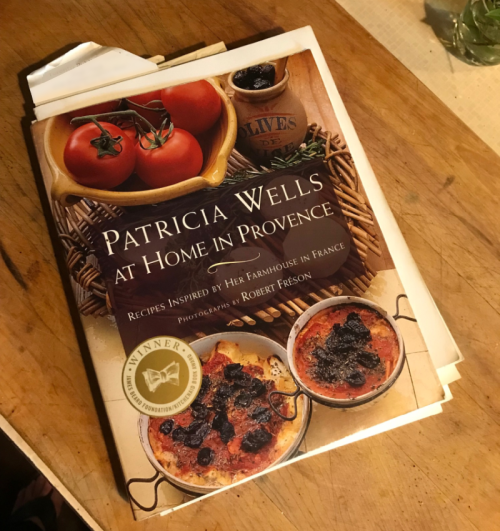
After savouring a public library copy of the hard cover version of this lovely cookbook, we ordered our own copy: the paperback version.
The paperback is very very different. The words appear to be the same. But the beautiful photographs that went with almost every page are not there! There are two inserts of many of the photos. But it’s just not the same. […]
But here’s the really upsetting thing. As I was leafing through our brand new paperback (and I wasn’t being rough!), the spine broke! Already! Yet the much older public library copy of the hardcover version has been read and thumbed through by many people many times. The binding still seems quite secure. They JUST don’t make things the way they used to!
– me, goodreads review, July 2009
It gets worse every time we open the book. (If it wasn’t such a great cookbook, we would have thrown it out long ago.)
One of our nieces had just arrived in town to go to university here. A friend of hers works in a stellar bakery (all their bread is made with wild yeast) They came over one morning for a late breakfast, bringing various wonders from the bakery. One of those wonders was a wild yeast olive oil bread that the bakery calls “focaccia”. Well. It was nothing like any focaccia we’ve ever seen.
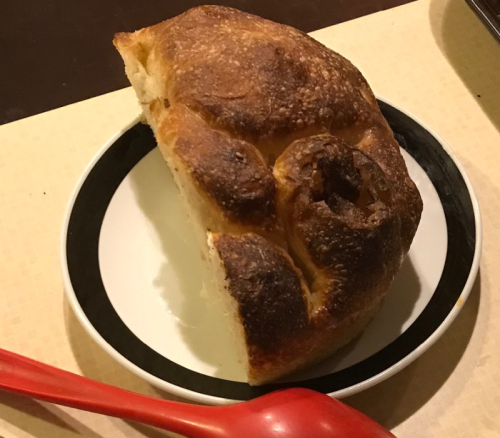
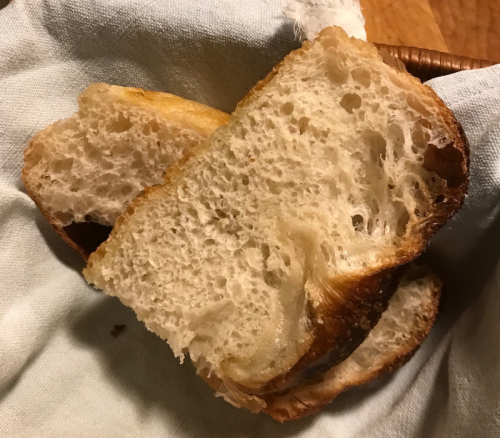
‘Focaccia’ from Emmer Bakery (Toronto)
Shortly after feasting on this amazing “focaccia” from the Emmer Bakery (at corner of Harbord and Borden Streets), we got to the Bread section in Patricia Wells’ book to read about “Pompe à l’huile: Provençal Olive Oil Brioche”. It sounds JUST like the “foccacia” we had just had!
On any given day in Provence I can be found in the kitchen first thing each morning, mixing, kneading, concocting a bread, a biscuit, the makins of a bread tart or a pizzalike fougasse. I know of few acts that give a cook as much spiritural nourishment as making bread. […] Bread is patient, bread is flexible, bread is responsive. […]
POMPE À L’HUILE: PROVENÇAL OLIVE OIL BRIOCHE
Years ago I made an olive oil brioche — known as pompe à l’huile — to celebrate our first Christmas in Provence. […] I resurrected it recently, and in the period of a single week, made more than half a dozen versions. […] Each morning, guests came down to breakfast and headed for the bread drawer, cutting off thick slices of brioche to toast and sample with homemade jam. Few recipes are as versatile as this one.
In the region of Aix-en-Provence it’s know as the gibassié; in Manosque they call it fougasse; in the northern part of the Vaucluse it may be called pogne; but by any name pompe à l’huile is sacred in Provence
I bake bread every few days, usually a sourdough loaf […]. Since I know that not everyone has the time or desire to keep a sourdough starter active, I have developed a yeast version
– Patricia Wells, Patricia Wells at Home in Provence, ‘Bread’ Intro, ‘Pompe à l’huile: Provençal olive oil brioche’, and ‘Sesame, Flax & Sunflower Seed Bread’; p.163-165, 175
So. That is the recipe I chose for us to make this month. Here is how I have revised Patricia Wells’ recipe for the BBBabes. (Patricia Wells calls for orange blossom water in the dough. I’m not wild about the flavour of orange blossom water, so I left it out. I also left out the egg yolk for glazing because I’m lazy.)
Use the recipe as is, or modify it to your tastes. Happy baking!
I feel a recipe is only a theme, which an intelligent cook can play each time with a variation.
Madame Jehane Benoît (1904-1987), OC
Madame Benoît, 1922 graduate of the Sorbonne in Paris in food chemistry, was a maven of Canadian cuisine – particularly the cuisine of Quebec; in 1973, she received the Order of Canada for her contributions to the art of Canadian cuisine. I’m guessing that Madame Benoît’s quote was en français: Je pense qu’une recette n’est qu’un thème qu’un cuisinier intelligent peut jouer à chaque fois avec une variation.
Alas, I have failed to find the source of this quote in any of the several books Madame Benoit published. (The Internet Archive library is usually very useful for these searches.)
Olive Oil Brioche
based on Patricia Wells’ recipe for ‘Pompe à l’huile: Provençal olive oil brioche’ in “Patricia Wells At Home in Provence”, Scribner 1996I’m a brioche lover but pretty much stopped making it because of the high butter content. This recipe — using only extra-virgin olive oil as the fat — is ideal for today’s world. It’s light, only mildly sweet, and right at home on the breakfast, lunch, and dinner table — in short, a hit!
– Patricia Wells, ‘Pompe à l’huile: Provençal olive oil brioche’, Patricia Wells At Home in Provence, p. 164makes one large ring
WILD LEAVENER
50 grams water
50 grams 100% no-additives whole wheat flour
spoonful (15-20 grams) of Jane Mason whole wheat starter from the fridgeDOUGH
600 grams unbleached ‘no-additives’ all-purpose flour
15 grams wheat germ
4 grams sugar
Grated zest of 1 orange, preferably organic
Grated zest of 1 lemon, preferably organic
200 grams lukewarm water
1 gram (3/8 teaspoon) active dry yeast (optional)
all of wild leavener from above
45 grams extra-virgin olive oil
2 large eggs, room temperature
12 grams sea salt + 10 grams waterTOPPING
egg yolk, cream or milk, for brushing to make a glaze (optional)1. WILD STARTER: Late in the evening on the day before the day you will be baking the bread: Put the starter ingredients into a smallish bowl. Mix with a wooden spoon until the flour is stirred in well. Cover the bowl with a plate and set aside overnight in the oven with only the light turned on if it’s still cool in the kitchen, or with the light turned off if the nights are warm.
2. DOUGH: a.) Check that a small spoonful of the leavener floats in a small bowl of room temperature water. If the leavener does not float, elect to add a little commercial yeast. Even if it does float, but you are nervous, go ahead and add a little commercial yeast by whisking lukewarm water and yeast together in a small bowl. Set aside.
b.) Place a sieve over a bowl large enough for the final dough to triple in volume, and dump in the all-purpose flour to sift. (You want to remove any lumps of glue that might have slipped in after the struggle to open the bag. With some of our bags of flour, there have been at least 5 or 6 suspicious looking lumps left in the bottom of the sieve.) Add wheat germ, sugar, all of the bubbling wild starter, and all of the water (with yeast if using). Use the dough whisk (or wooden spoon) to whisk it all together, making sure that all the flour is absorbed. Cover the bowl with a plate and allow to rest for about 30 minutes.
c.) ADDING THE EGGS, OLIVE OIL, and SALT: Briefly whisk the eggs in a bowl then pour them and the olive oil over top of the dough. Then a small bowl, whisk the salt into 10 grams of water. Add the salt mixture to the top of the dough.
d.) KNEADING: Run one of your hands under water and use it to squoosh the oil, eggs, and salt water into the dough; use the other hand to steady the bowl – this way you always have a clean hand. At first the dough might feel a bit messy and a bit sticky, but suddenly, it will seem more like dough than weirdly folded, slimy glop. Keep folding it over onto itself until it is relatively smooth.
e.) STRETCHING AND FOLDING: About 30 minutes after adding the salt, run your working hand under water again. Reach down along the side of the bowl and lift and stretch the dough straight up and almost out of the bowl. Fold it over itself to the other side of the bowl. Turn the bowl and repeat four or five times more. Stop if it’s a little difficult to stretch the dough up any more. Cover with a plate and leave on the counter for about 30 minutes.
Repeat this step 3 or 4 times, with 30 minute intervals between. You’ll notice that after each time, the dough feels significantly smoother. f.) PROOFING: Making sure that the dough bowl is covered with a plate, leave the dough in the oven with only the light turned on (or if the kitchen is hot, on the counter) to allow the dough to double or almost triple.
Let the dough rise in the refrigerator until doubled or tripled in bulk, 8 to 12 hours. (The dough can be kept for 2 to 3 days in the refrigerator. Simply pumch down the dough as it doubles or triples.)
– Patricia Wells, ‘Pompe a l’huile: Provençal olive oil brioche’, Patricia Wells At Home in Provence, p.1653. PRESHAPING: Make sure the dough is at room temperature. If it has been in the fridge, Patricia Wells suggests removing it from the fridge and hour before you plan to bake the bread. Shape the dough into a round. To do so, fold each piece like a business letter. Then gently grabbing the side of one of the ends, make a false braid. Fold the top half over to the middle and gently make another false braid. The dough will want to roll in on itself. This is a good thing. Once it shapes itself into a quasi-ball, put it seam-side down on the board and gently turn it round and round to smooth out any rough edges. Cover the round with the overturned (clean) mixing bowl. Leave to rest for about 10 minutes.
4. SHAPING: Gently press the round into a circle that is not too thick and not too thin. Use your fingers to make a hole in the center to form a ring. Put the ring on a parchment-covered baking sheet, with a
well flouredwell oiled oven-proof cup (tea orround measuring cup) to keep the hole from closing. Cover with a clean tea towel and allow to rise to about double. Patricia Wells suggests that this will be about an hour.5. BAKING: Preheat the oven to 425F. DO NOT even try to remove the cup from the center of the bread. Gently brush the top of the loaf with egg yolk, cream or milk, if using. Put the baking sheet into the center of the oven. Immediately turn the oven down to 400F. (Opening the door of the oven always causes it to lose heat; this way, the oven will start baking the bread at 400F as per Patricia Wells’ instructions.) Bake for 30 to 50 minutes, until the ring is “a deep, golden brown” and the internal temperature is around 210F.
6. COOLING: When the bread is done, remove it from the oven and allow to cool on a well ventilated rack. Wait until it is cool before removing the cup in the center or cutting into the loaf. When the bread is just out of the oven, it is still continuing to bake inside!
+++++++
NOTES:
:: Variation: Patricia Wells says that in Provence, this olive oil bread can be seasoned with “about 1 teaspoon of fennel grains or even rolled into two layers and flavored with several tablespoons of quince jam (confiture de coings) between the layers”. Also, in her recipe, she calls for adding 1 Tablespoon orange flower water. It isn’t easy for us to get orange flower water, but it is available in middle Eastern stores. (Our favourite Turkish store carries it, but I confess that, after the first thrill of tasting it, neither of us is wild about the flavour it adds now.):: Starter and what kind of yeast: Patricia Wells simply calls for using dry yeast; neither suggest using a wild starter. But she also says that she usually makes sourdough bread. In her recipe for ‘Sesame, Flax Sunflower Seed Bread’ , she states “Since I know that not everyone has the time or desire to keep a sourdough starter active, I have developed a yeast version.” It seems quite likely that she also makes her brioche, using her sourdough starter. And. We have our trusty Jane Mason starter in the fridge. And it seems a shame not to use it, even if I am adding commercial yeast. Active dry yeast, because that’s what Mum always used.
Ingredients list for ‘Pompe à l’huile: olive oil brioche’ in “Patricia Wells At Home in Provence”:
1 tsp active dry yeast
1 tsp sugar
250ml water
50 ml extra-virgin olive oil
2 large eggs, room temperature
2 tsp fine sea salt
Grated zest of 1 orange, preferably organic
Grated zest of 1 lemon, preferably organic
1 Tbsp orange flower water or tap water
665 grams unbleached all-purpose flour
1 beaten egg yolk, for glazing
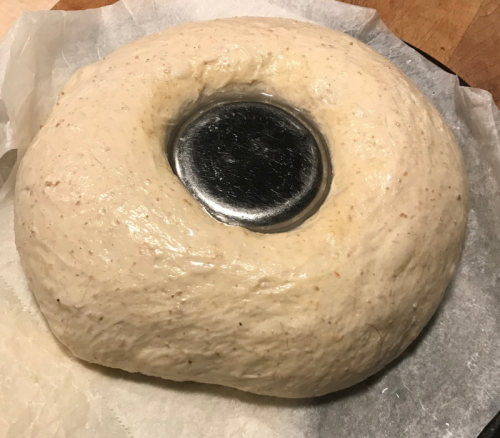
:: Shaping and retaining the hole: Rather than rolling the dough out into a circle, I formed it into a boule and then, before placing it on a parchment-papered pizza pan, ran my hand under the tap and used wet fingers to create a hole in the middle. I then oiled the outsides of a stainless steel measuring cup to put into the hole. I baked the bread with the cup still there, and waited until the loaf was completely cool before pushing the cup out. The oil makes the difference.
:: Why the focus on weights: I always measure bread ingredients – particularly the salt – by weight. There really is no other way to go.
WEIGHING VERSUS MEASURING […] [H]abits are hard to change. Your mother and grandmother probably didn’t use scales, and you may even have their measuring cups in your kitchen drawer. But using a scale will change the way you cook and bake for the better in many ways.
– Thomas Keller, ‘Throw out your measuring cups’, Bouchon Bakery
Kitchen Scale An absolute must, the single tool that is not optional. Weighing your ingredients, as opposed to measuring by volume, is far more accurate, and this is the first tool I recommend any baker purchase. Measuring flour (and salt!) by volume using measuring cups is incredibly inaccurate
– Maurizio Leo, ‘the Must-have tools’, The Perfect Loaf
[S]alts differ widely, so that a given volume of some salts will weigh less than others. For example, fine table salt is generally heavier per volume than coarse salt; and even within those two categories, there are large variations.
– Naomi Duguid, The Miracle of Salt
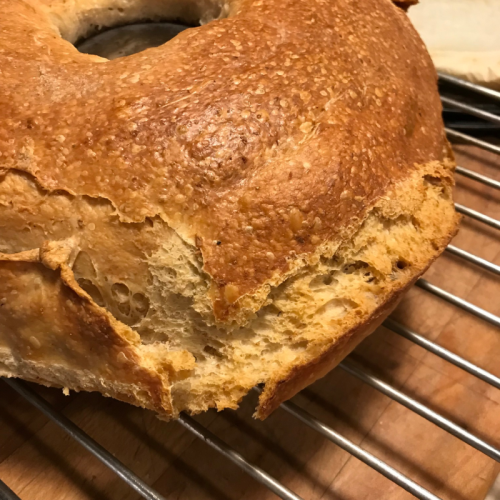
La pompe à l’huile provençale est un dessert traditionnel de la région Provence-Alpes-Côte d’Azur en France. […] Cette brioche parfumée à l’huile d’olive et à la fleur d’oranger est à la fois moelleuse et savoureuse. […] Pour une saveur encore plus authentique, choisissez une huile d’olive de qualité, idéalement en provenance de Provence. Cela apportera une touche aromatique supplémentaire à votre pompe à l’huile. [Pompe à l’huile Provençale is a traditional dessert in the French region of Provence-Alpes-Côte d’Azur. […] This brioche perfumed with olive oil and orange flower is both moist and flavourful. […] For a flavour even more authentic, choose a good quality olive oil, ideally one from Provence. This brings an extra aromatic touch to your pompe à l’huile.
– Olivier Renaud, À la Ferme Dulys | Recette de pompe à l’huile provençale : une tradition gourmande
Before [Georges] Testa can hang up his apron for the day, though, he must finish some last minute baking, including several hundred sweet olive oil breads called pompes à l’huile. A cherished local favourite, these light, golden rounds are the most important component of the sacred 13 desserts that accompany Christmas meals. I follow as Testa heads downstairs to his hotk, chaotic kitchen, where a few of his old pals, who help him on this busy day every year, focus on the pompes […] Robert Viatore brushes the finished loaves with hot water to keep them moist.
[…]
In a final ritual, the youngest person in the room stands. This year it is 15-year-old Lauraent Merle […] “Who is the oldest present?” he asks. […] [Joe] nobly admits to it. Lauraent grins and raises the pompe à l’huile high and then brings it down on Joes head, splitting it apart. Everyone, including Testa, laughs. “We never cut the pompe à l’huile,” he explains. “That could cut the friendship.”
– Nancy Coons, Provence Noël, SAVEUR no.98, December 2006, p46
Naturally, comme d’habitude, when I gave this recipe to the BBBabes, I hadn’t yet made it. Of course I hadn’t!! (Cue: hysterical laughter)
Here is how things went making this October’s BBB project:
BBB Olive Oil Brioche Diary:
3 October 2026, 11:03 Ha. How’s this for altering the very recipe that I gave to the BBBabes? I started mixing the dough this morning, and realized that I neglected to buy an orange. Or even to put it on the grocery list. But we do have lemons. So I used the zest of two lemons.
I started really late today… I hope that doesn’t mean that we’ll be baking bread tonight AFTER dinner. I did cave in and add commercial yeast. Not only have I neglected filling out the grocery list, but I have also neglected our Jane Mason starter. It’s alive and bubbly but it’s not really really strong.
I haven’t added the eggs and oil yet, so the dough is really really really stiff. So stiff that I added an extra splash of water.
See what I mean about making changes??
I am embracing Madame Benoit’s suggestion that a recipe is only a theme. And I’m going to pretend that I’m an intelligent cook. Or at least an average one.

[L]a plupart des gens peuvent acquérir de modestes connaissances concernant la préparation des aliments. Une recette de base, parfaitement comprise, permettra même à un cuisiner moyen de créer des variantes, sans l’aide de livre de cuisine. [ Most people can gain modest knowledge regarding food preparation. A basic recipe, fully understood, will allow even an average cook to create variations, without the help of a cookbook. ]
– Jehane Benoit, Mes secrets de la bonne cuisine [My Secrets of Good Cooking], p.10
13:33 Well. If I ever make this again, I will definitely add at least one of the eggs at the beginning. About an hour ago, it took me ages to pummel the half slurry half solid brick of flour and water into submission. I ended up having to turn the whole mess out onto the board and smear the sludge across, pressing down with my thumbs to reduce the lumps.
Have I succeeded? Hmmm. Maybe. But at least it’s looking more like dough now than it did.
13:54 I just reported my experience (failings???) to the BBBabes and added the following to 2b in the instructions. “Warning: the dough will be pretty stiff at this point. Avoid the urge to add more water.”
But. Who ever reads instructions now anyway? We all just follow previous instructions we’ve used that work for us, right? {cough}
18:46 I. Am. Not. Designed. To. Bake. Bread!
About half an hour ago, I suddenly remembered about the dough rising in the oven. Mercifully, around 3pm after stretching the dough one last time, I turned the light off because the dough and the oven seemed quite warm.
So. (Ha. Is it okay to begin and end a sentence with “so”?) Because I turned the light off and because the kitchen is on the chilly side (around 18C), all’s well that ends well. I hope.
The dough had risen perfectly! There were no lumps anymore. It was easy to form a round. And equally easy to poke a hole in the center. I olive-oiled our stainless steel cup measure to put into the center of the ring to stop it from closing up.
The cup measure is perfect because the handle fell off at some point several years ago. I was quite annoyed at the time. But now I’m not. I’ll be able to leave it there when the bread is baking.
I can’t believe that Patricia Wells suggests using a tea cup to keep the hole in the center from disappearing as the bread rises. And then!! She suggests removing the tea cup before baking the bread. How would that be possible???
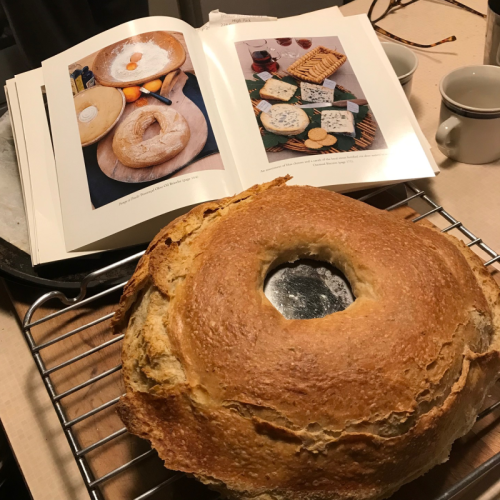
Not to mention that the photo of her bread and bread form displays that she has a special banneton.
Punch down the dough, roll it into a cicle, and shape in the form of a crown, forming a small hole in the center of the crown. Place on a nonstick baking sheet, with a small teacup in the hole to keep it from closing up as the dough rises. […] Preheat the oven […] Remove the towel and the teacup, and brush the dough with the egg yolk glaze.
– Patricia Wells, Patricia Wells At Home in Provence, p165But. I didn’t look at these instructions nor what I had sent to the BBBabes in my paraphrasing. Naturally I didn’t. Because I’m an expert!! {cough} I went ahead in my “intelligent” manner to form a boule and then run my hand under the tap and use wet fingers to create a hole in the middle.
Gently press the round into a circle that is not too thick and not too thin. Use your fingers to make a hole in the center to form a ring. Put the ring on a parchment covered baking sheet, with a
well flouredwell oiled oven-proof cup (tea orround measuring cup) to keep the hole from closing.
– me, BBB October 2026 recipe
The bread ring is now in the oven with only the light on.
Look at me
learning my lesson (again): I have set the timer to check it for turning the oven on.
4 October 2026, 11:23 While the bread was baking, we were too busy with dinner and a movie for me to continue my voluminous report….
Well. Did I mention something about pretending to be intelligent? Or at least average? Hahahahahahahahahaha
I decided that it would be a good idea to use our upside-down large stainless steel mixing bowl as a hat for the first 15 minutes of baking.
And it might have been a good idea if I had oiled the insides of the bowl.
I wrestled the bowl off of the half-baked bread, then wrestled as much of what was stuck to the insides of the bowl and jammed it onto the loaf in roughly the right places. Back into the oven it went. For MORE than an additional 15 minutes.
Bake until the brioche is a deep golden brown, about 30 minutes, turning the baking sheet from time to time if the oven is heating unevenly.
– Patricia Wells, Patricia Wells At Home in Provence, p165I baked the bread for a total of about 50 minutes, until the internal temperature was around 210F.
The stainless steel measuring cup was still stuck fast. I didn’t dare trying to remove it when the bread was still hot and baking inside.
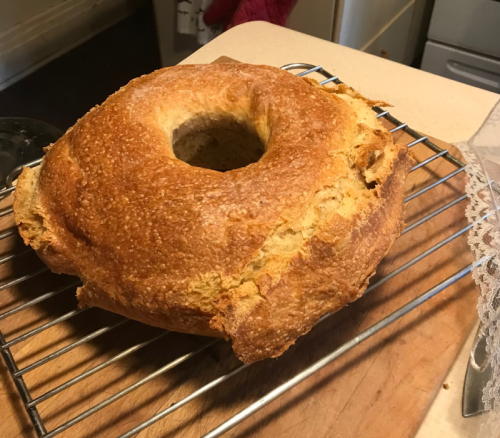
But the bread looks fabulous!! In spite of its torn sides. Or maybe because of its torn sides.
I took it off the pan and put the loaf onto a rack to cool overnight.
Late last night, when the bread was cool, the measuring cup popped out easily. Yay.
We’re planning to serve the bread for dinner tonight with lentil soup, salad, and fancy cheese from our second favourite cheese shop just a few blocks away. We’ll walk down this afternoon to see what they have.
I can’t wait for dinner!!

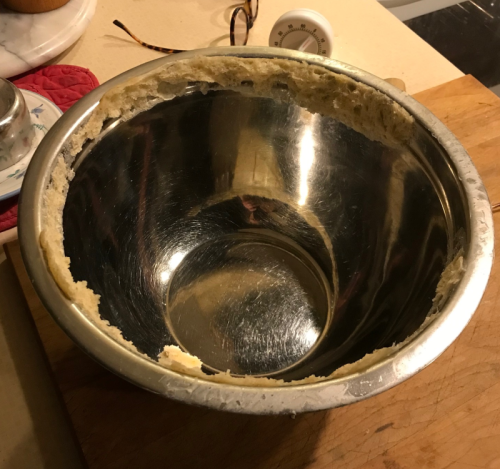
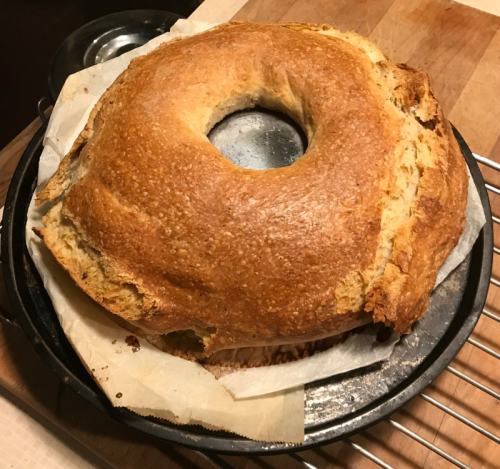
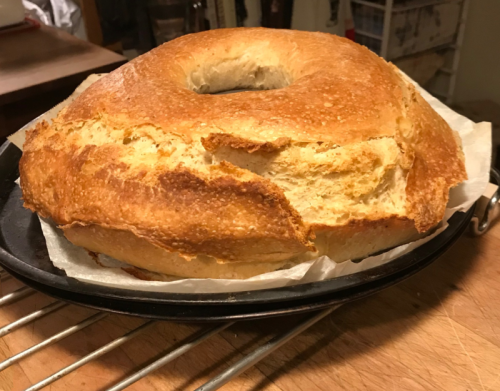
As it came out of the oven, the bread looked and smelled great!! In spite of a few difficulties I had with the crust splitting (that mistake of putting a too-small stainless steel bowl as a hat on the bread for the first half of baking…). I had to pry parts of the crust off the sides of the bowl and jam them back on for the rest of the baking. I couldn’t believe that they actually stayed!
We refreshed the bread in the oven just before sitting down to a most lovely dinner. The soup, salad and cheese were brilliant.
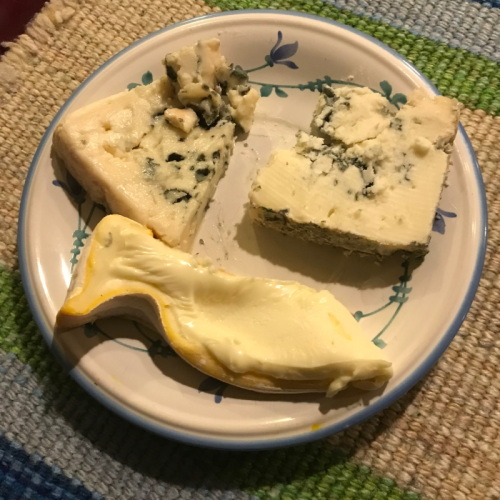
Top Left: Bleu d’Elizabeth (cow’s milk, Quebec);
Top Right: Roquefort (sheep’s milk, France);
Bottom: Vacherousse (cow’s milk from the Jura, France)
And the bread? It was beautiful. And the crust was lovely. It was good.
And it looked just like the photo in Patricia Wells’ book. {snort}
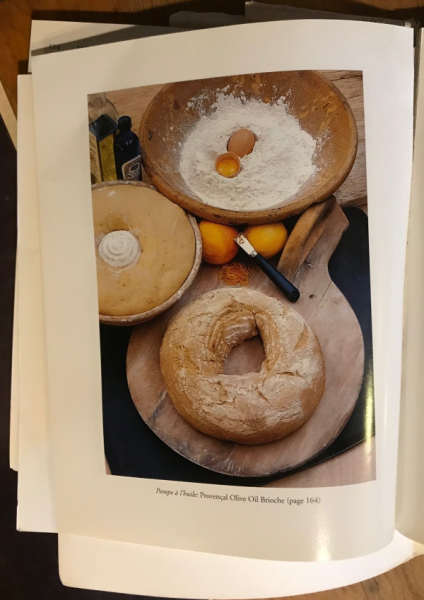
photo: Robert Freson
And look at that crumb!
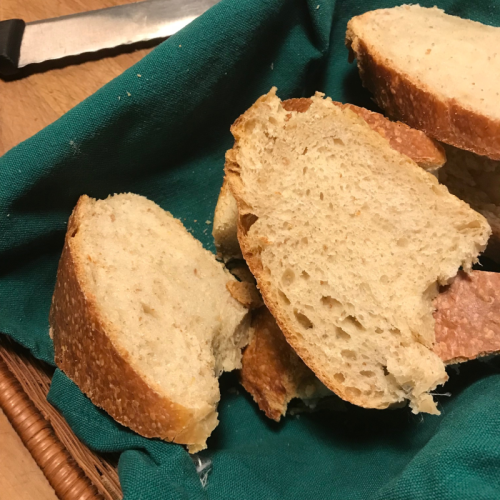
But, was this the most special bread ever? I’m not so sure. Perhaps it really does need the orange zest. Or even the orange blossom water. And maybe adding some fennel seeds would do the trick. And maybe throwing in a little bit of rye flour to boost the flavour.
Will I make this again? The jury is still out.
But. Please don’t let our experience stop you from making this bread! It is still a thousand times better than super market bread.
Bread Baking Babes
Olive Oil Brioche
As you know (if you’ve managed to get this far), I am hosting October 2026’s Bread Baking Babes’ project. I wrote:
Patricia Wells’ “Pompe à l’huile: Provençal olive oil brioche” is the recipe I’m choosing for us to make in October. I haven’t yet translated Patricia Wells’ olive oil brioche recipe back into a wild yeast version. As soon as I do, I’ll post our BBB recipe.
But just in case you’d like to use commercial yeast, here is Patricia Wells’ version of her recipe for POMPE À L’HUILE: PROVENÇAL OLIVE OIL BRIOCHE:
Internet Archive: Patricia Wells At Home in Provence (if you cannot view this page, I encourage you to sign into the Internet Archive. It is free. And it is the most useful resource, particularly of out of print, but viable, books.)
And I know. This bread is somewhat similar to the Olive Oil Wreath we made in April 2021….
– me, excerpt of September 2026 message to BBBabes
To receive a Bread Baking Buddy Badge to display on your site: make the Olive Oil Brioche in the next couple of weeks and post about it (we love to see how your bread turns out AND hear what you think about it – what you didn’t like and/or what you liked) before the 29 October 2026. If you do not have a blog, no problem; you can also post your picture(s) to Flickr (or any other photo sharing site) and record your thoughts about the bread there. Please remember to contact the Kitchen of the Month to say that your post is up.
Here’s how to let us know:
- email me
» Remember to include your name and a link to your post
» Please type “BBB October 2026 bread” in the subject heading
Please note that it’s not enough to post about your bread in the Facebook group. Because of the ephemeral nature of Facebook’s posts, your FB post may be lost in the shuffle. Please email if you want to be included.
For complete details about this month’s recipe, the BBB and how to become a BBBuddy, please read:
- BBB Kitchen of the month:
me, blog from OUR kitchen, BBB October 2026 - BBBuddy guidelines
- about the BBBabes
Please take a look at the other BBBabes’ October 2026 Olive Oil Brioches:
- Aparna, My Diverse Kitchen
- Cathy, Bread Experience: Rustic Pompe à l’huile: Why This Olive Oil Brioche Wanted Poolish, Not Sourdough
- Judy, Judy’s Gross Eats: Bread Baking Babes: Pompe à l’huile: Provençal Olive Oil Brioche
- Katie (BBBBB), Thyme for Cooking
- Karen K, Karen’s Kitchen Stories: Pompe Á L’Huile – Provençal Olive Oil Brioche
- Kelly, A Messy Kitchen: Pompe à l’huile – Olive Oil Brioche #BBB
- Tanna, My Kitchen in Half Cups: POMPE a l’huile: olive oil brioche
Nyons olives are part of the Tanche family, a type of olive grown in France’s southern region and is the first kind of olive to have received France’s AOC designation (via Baronnies Tourism). The AOC label is highly prestigious and marks a group of protected olives and olive oils that are produced under a very specific set of guidelines, according to La Compagnie de l’huile d’Olive. Olives earning AOC approval have come from trees that are at least five years old and have been pruned only once every three years. Also, the water used throughout AOC-approved olive groves must pass strict regulatory requirements.
One other thing that differentiates Nyons black olives is the time at which they are removed from their stems. Very Gourmand notes that this variety is harvested when it is fully ripe and slightly wrinkled from the cold weather season.
[…] these olives will always turn into a wrinkled, dark shade known as “monk’s habit.” Barral describes the olive’s taste as subtle with a generous texture; while Taste of France notes a fleshy, fruity flavor profile with sweet scents of nuts, candied fruit, and chocolate.
– Michelle Welsch, Tasting Table | What Makes Nyons Olives Unique
Olives noires de Nyons
Drôme, France Drôme, France
The Tanche variety of olives from Nyon are a specific shade of brown, almost black, and are finely wrinkled. They are hand-picked in November and December and then sorted according to their intended use. Olive oil is produced only from the smallest olives, while the bigger ones can be eaten on their own, as appetisers or used in salads or omelettes. The olives have a mildly salty and pleasantly bitter taste. They are commonly dry-cured in salt, to pull the moisture and bitterness out of them, and packed in olive oil. Olives noires de Nyons pair nicely with cheese, almonds, onions and a variety of spices.
– Taste Atlas, Olives noires de Nyons
The inimitable Jamie Schler posted about Olive Oil Brioche in November 2023. She wrote:
In 1875, Augustin Chaissang, writing for the Academic Society of Puy, in the Auvergne Rhône-Alpes region of France, published the diary of one Jean (Jehan) Burel, born in 1540 […] And Jean Burel, in 1572, in the pages of his diary, mentions the local specialty pompe for the first time in writing: Pompes et petits pains – pompes and bread rolls – were made and given as charity to the town’s poor, most particularly in times of famine and hardship.
[…]
During the years 1579 and 1580, the town saw the arrival of 4,000 men, women, and children from the mountains “dying of hunger…a pitiful and lamentable sight”. […] “…So great was the famine and the necessity,” Burel continues, “that the city…ordered… the preparation of pompes which would be distributed and sold to the poor inhabitants with the means to bake them in their own homes.” Pompes were also given to the poor on the Feast of the Ascension
[…]
Pompe à l’huile – literally oil pump – gets its unusual name from the ancient process in Provence of the millers tossing flour into the presses at the end of the olive oil production process to soak up – or pump – the residual oil at the bottom of the vats or tanks. This olive oil-moistened flour, so as to avoid waste, was then turned into bread. […] According to tradition, if the pompe is cut rather than torn, one risks ruin during the year to come. On the flip side, the pompe à l’huile, ritually made, baked, torn by hand, and eaten, is a symbol of success.
[…]
I never imagined, when developing and testing this recipe, that something so simple and so delicately flavored could be so outrageously good.
– Jamie Schler, Life’s a Feast by Jamie Schler | La Pompe à l’Huile “The Christmas dessert par excellence”
Which brings us to the following. Alas, in the times since the order for pompe à l’huile to be distributed to the impoverished, our world has yet to erradicate hunger:
World Food Day
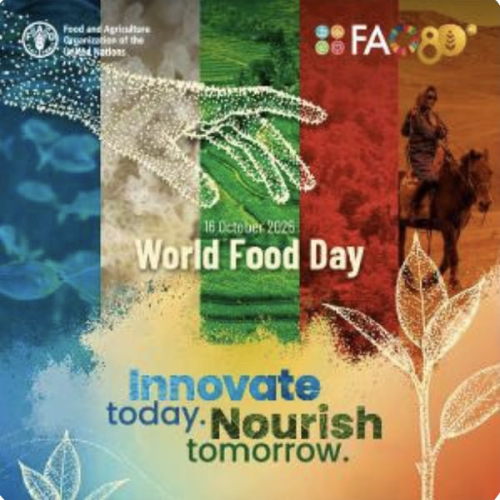
Innovate today. Nourish tomorrow. – FAO.org
Innovate today. Nourish tomorrow.
Ending hunger is within reach. The world already produces enough food to nourish everyone, yet 645 million people still face hunger, and 2.69 billion cannot afford a healthy diet. As conflict, economic instability and climate shocks put pressure on agrifood systems, the challenge is how to ensure access to reliable, affordable and nutritious food for people everywhere.
[…]
Innovation is transforming how food is produced, stored, transported and marketed. […] Together, our efforts to foster innovation can build agrifood systems that are more stable, more inclusive and more resilient – capable of nourishing people today while protecting the resources future generations depend on.
– FAO of the UN, World Food Day 2026(fao.org/world-food-day/about/en)
Food is a basic human right.
Yet around 645 million people faced hunger last year. And nearly 2.7 billion people cannot afford a healthy diet.
Overlapping shocks and crises are adding to these pressures. Disrupting production and supply chains. Driving up the cost of food and fertilizer. And putting nutritious diets further out of reach for millions. We have the knowledge, technology and capacity to feed the world. It’s time to use it.
[…]
Together, let us ensure that every person, everywhere, has access to safe, nutritious and affordable food.
– Secretary-General António Guterres, ‘António Guterres (Secretary-General) on World Food Day 2026’, message on 2 October 2026 (press.un.org/en/2026/sgsm23313.doc.htm)
World Bread Day
 Please note that today is also World Bread Day. World Bread Day is an annual event set to coincide with World Food Day, where participants are invited to bake bread and share it. World Food Day is a yearly event put together by the UN Food and Agriculture Organization (FAO) to raise awareness and funds to feed the world’s chronically hungry.
The scent of freshly baked bread will soon be filling our kitchens again – and I’m incredibly excited about it: On October 16, 2026, we will be celebrating the 21st edition of World Bread Day!
For many years, this special day has brought bread bakers from all over the world together to celebrate the diversity and fascination of bread baking. From just a few simple ingredients, we can create wonderfully delicious loaves and rolls time and time again – a true treasure trove of flavor and tradition.
– Zorra, Kochtopf | World Bread Day 2026 – Einladung / Invitation
For more information about World Food Day and World Bread Day 2026, please read the following:
- 1x umrühren bitte, aka Kochtopf: World Bread Day 2026 – Einladung / Invitation – 21th year!
- FAO of the UN: World Food Day 2026
There are many reputable aid agencies working to help feed the chronically hungry worldwide. Here are just a few of them to help you to help those in need. Please look in your community for how you can help.
- Charity Intelligence Canada:
“To provide Canadian donors with information that helps them make informed and intelligent giving decisions to have the greatest impact”
» A-Z Charity Listings
» 2026 Top 100 Rated Charities
» understanding our ratings - Agencies working within Canada
» Canadian Association of Food Banks “Right now, 1 in 4 people in Canada don’t have access to the food they need to be at their best. Hunger holds us back. Food banks provide possibilities, opportunities, and the chance for everyone to thrive.”
» Second Harvest “Nearly 1 in 4 people don’t know where their next meal is coming from. 46.5% Of all food in Canada is wasted EVERY YEAR.”
» Daily Bread Food Bank “Food is a human right. We are on a mission to eliminate food insecurity and advocate for solutions to end poverty.”
» Feed Ontario “Together, we can work to feed our communities […] We are on a mission to eliminate food insecurity and advocate for solutions to end poverty.”
» FoodShare “Food is a Right. FoodShare Toronto advocates for the right to food and challenges the barriers to achieving food justice.”

Working together with the
World Food Programme
to prevent hunger
(As always, if you have something to add or say about ending world hunger, please remember to post your thoughts and ideas on your blog, facebook, at work, etc. etc.)
- Related:
» Apricot Kolache and Brioche (BBB July 2023)
» Wild Olive Oil Wreath (BBB April 2021)
» In the Heat of the Night (BBB August 2018)
» Dreaming of Orange Blossoms – Fouace Nantaise (BBB January 2017)
» Brioche flower; or is it a star?? (BBB December 2014)
» Look!! Aren’t those Nyons Olives?
» Brioche et un petit Gateau a la Creme (BBB March 2013)


So… the torn sides just give you something to grab onto to tear off a piece! Right? Thanks Elizabeth for the introduction to this fabulous bread.
edit 16 October 2026, 17:46 Yes, Karen! That’s it! (I wish I’d thought of that….) I’m so glad you like the bread. – Elizabeth
Always a fascinating adventure in bread baking! Loved the bread. Happy World Bread Day!
edit 16 October 2026, 17:48 Ha. Yes, it was certainly an adventure, Judy. (Isn’t EVERY day World Bread Day?) – Elizabeth
Elizabeth, Thanks for a delicious monthly bake! Your crumb looks lovely! I got a bit distracted while testing different versions, but I had fun along the way.
edit 16 October 2026, 17:49 Thank YOU for all your testing, Cathy. And it’s so great that your bread turned out so stunningly beautifully. Distractions like that are the best, don’t you think? – Elizabeth
It was probably somewhat sacrilegious for me to not use olive oil in this Olive Oil loaf… But I really loved how it turned out!
edit 16 October 2026, 17:51 Shhhhh!!! Don’t tell anyone! (I suddenly neeeeeeed to get a bottle of avocado oil to try it in bread!) I’m so pleased that you liked your bread so much, Kelly. – Elizabeth
Well, Elizabeth all I can say is … somehow I got it into my mind I had baked this … then I got it into my head I thought this was for next month … today I find I have not baked this and I am out of town (in motels) until Monday. I promise I will bake next week.
I love your loaf! It’s beautiful ragged side and all. I recently made the same mistake not buttering the lid on a Pullman loaf.
edit 16 October 2026, 17:54 It’s a miracle that I managed to post this on time. I got thrown off by Labour Day being so late. Then Thanksgiving was really late too.
I have to admit that we really loved the ragged side. The texture of the extra crust was very welcome. And. The bread makes pretty brilliant toast.
Safe travels and happy baking when you get home. I look forward to see how you manipulate the ingredients, Tanna. – Elizabeth